
CategoriesMobility AI Smart Cities

The Convergence of IoT, Edge–Cloud and Big Data in Smart Cities

As cities worldwide accelerate their digital transformation, the integration of IoT-enabled infrastructure, Big Data analytics and edge–cloud architectures have become cornerstone of intelligent urban ecosystems. These domains — individually potent — unleash exponential value when deployed in a unified, interdependent framework.

1. IoT-Enabled Infrastructure: Foundational Data Fabric

Modern urban systems are increasingly embedded with sensors, actuators, PLCs, RTUs, RFID, LIDAR, GPS, and V2X modules across mobility, utilities, and public safety domains. These devices collectively generate petabyte-scale telemetry, often at sub-second intervals. For instance, a mid-sized ITS deployment in Abu Dhabi can generate over 3 TB/day of raw sensor data across just 50 signalized intersections.

But without contextualization, raw IoT data has limited utility. That’s where downstream analytics, simulation models, and decentralized verification mechanisms enter the equation.

2. Big Data Analytics: Deriving Intelligence from Noise

The heterogeneity and velocity of smart city data call for a robust data lake–based architecture, integrating Apache Kafka, Flink, Hadoop, and NoSQL stores (e.g., Cassandra, MongoDB) with scalable ML pipelines.

Using predictive analytics and unsupervised learning, anomalies such as energy leakages, traffic bottlenecks, or air quality violations can be detected in real time. A recent MWB POC showed a 17% expected improvement in traffic throughput using AI-derived adaptive signal control based on fused IoT data and historic trends.

3. Edge–Cloud Continuum: Low Latency Meets Scalability

Latency-sensitive operations like real-time traffic control or autonomous vehicle handoffs demand processing at the edge (via NVIDIA Jetson, ARM Cortex, or custom FPGA setups), while historical model training, dashboarding, and policy simulations reside in cloud environments (AWS, Azure, G42).

5G and TSN (Time-Sensitive Networking) further enhance edge responsiveness, reducing latency to under 10 ms, critical for emergency response coordination or dynamic rerouting in congested corridors.

The Role of Digital Twins in Simulating the Urban Nervous System

Digital twins — dynamic, virtual representations of real-world assets — are central to scenario testing and failure prediction. Using platforms like CityIQ or Siemens NX, urban planners can model an entire city block’s mobility footprint, incorporating real-time IoT feeds, BIM data, and simulation loops.

A digital twin can be created to simulate a multi-junction arterial corridor, enabling scenario planning for lane closures, signal failures, and V2X-based rerouting.

Can Blockchain help?

Blockchain acts as a tamper-proof ledger for transactional and operational records — vital for multi-stakeholder environments like smart parking, permit management, or EV charging. Platforms like Hyperledger Fabric or Polygon Edge allow decentralized identity, immutable logging of asset state changes, and smart contract–based automation.

For example, a forward-looking smart WIM (Weigh-in-Motion) station could use blockchain to timestamp axle weight data, ensuring regulatory compliance and auditability with zero centralized trust dependency.


Smart cities of today and future demand multi-domain architectural thinking. The fusion of real-time IoT sensing, distributed analytics, digital mirroring, and decentralized trust is not just a future ideal but it’s a present imperative. MWB continues to integrate these paradigms to architect scalable, intelligent urban systems aligned with UAE Vision 2030 and beyond.

CategoriesITS Smart Cities

Smart Streets in Middle East – MWB Approach to AI-Driven Traffic Signals

Across the Middle East, cities aren’t just talking about smart mobility – they’re building it. From high density corridors to emerging developments, governments and planners are moving quickly to modernize how traffic is managed. One of the biggest upgrades? Implementing traffic signals with systems that think for themselves.

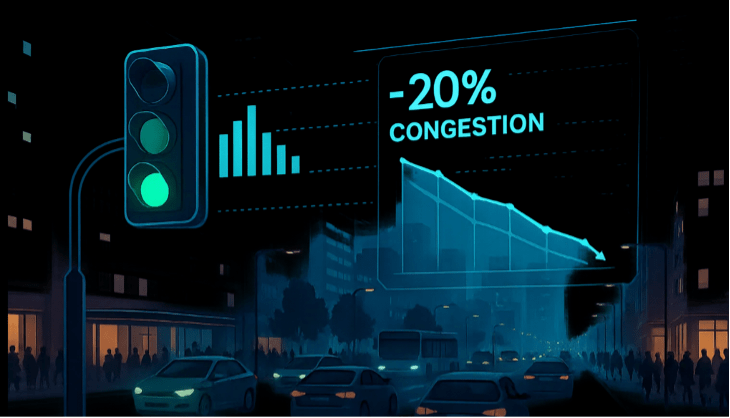
The Abu Dhabi Integrated Transport Centre launched initiatives with Google, one of which is ‘Project Green Light’, a program that collects and analyses traffic data at intersections and recommends improvements to enhance traffic light efficiency, reduces congestion and lower CO₂ emissions. Likewise, Dubai’s Roads and Transport Authority (RTA) plans to deploy AI to cut traffic signal wait times by up to 20%, with over 80 projects and initiatives planned over the next five years. Saudi Arabia has positioned itself as a global leader in technological innovation with rise of smart cities – NEOM being a flagship example. Lusail City in Qatar is developing a public transport system powered by AI technologies to enhance traffic flow while minimizing congestion.

At MWB, we’ve made it our mission to support cities through this transition. As an ITS and Intelligent Mobility Specialist Consultancy, we work closely with urban planners, transport authorities, and developers to make sure the move to smart signals is grounded in solid engineering and designed to work long term.

The Tech Is Powerful but It Needs Smart Design

AI, sensors, and edge computing are powerful technologies but only when used strategically. These tools can predict traffic build-ups before it happens and make split-second decisions to keep traffic flowing. But without the right design and strategy, the tech won’t deliver what cities need.

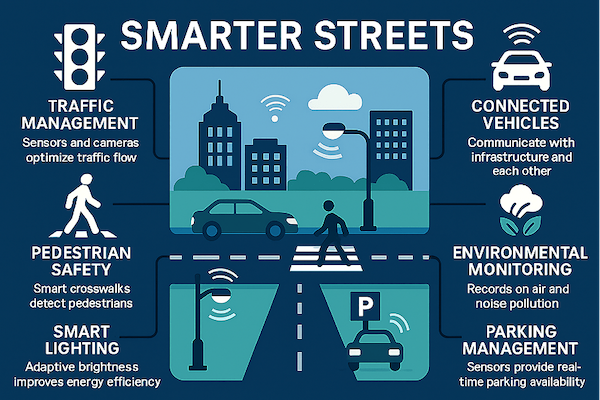
That’s where MWB plans to step in. Our approach starts with the big picture: how the traffic signal system fits into a city’s mobility plans. Then we break it down into what intersections to upgrade first, what hardware to keep or replace, and how to link everything together into a system that works across different modes of transport. Whether it’s syncing with bus arrival data or adjusting for air quality levels, we design with real world use in mind.

Our future deployments will be backed by measurable outcomes. We plan to track intersection delays, queue lengths, emissions, and system reliability – enabling cities to assess ROI with real data. This gives our clients the data they need to show clear return on investment and make smart decisions moving forward.

The Real Challenges and How We Solve Them

Upgrading to smart signals isn’t always straightforward. Cities often face three big hurdles: legacy infrastructure, tight budgets, and patchy connectivity. Here’s how we tackle each one.

Rolling Out Smarter Systems, One Step at a Time

We know most cities aren’t starting from scratch. Where possible, we intend to leverage existing infrastructure by incorporating modular upgrades like adaptive controllers or smart sensors. And we aim to support city teams during rollout phases to help ensure smooth implementation at each upgraded intersection.

MWB is developing phased upgrade strategies that will prioritize high-impact locations, places like busy intersections, accident prone spots, or roads near schools and hospitals. These pilot zones let cities see the benefits early and build confidence in the system.

Smarter Spending Without Compromise

A full system replacement isn’t always realistic or necessary. MWB aims to help clients maximize existing infrastructure in upcoming projects. That might mean keeping poles and cabinets, upgrading the internals, and installing intelligent hardware in phases.

We intend to support cities in developing strong business cases by using real traffic and environmental data to quantify impact by helping unlock funding from grants, government initiatives, or public-private partnerships.

Networks That Keep Things Running

Smart signals rely on fast, reliable communication- yet not every intersection is equipped with fiber or 5G. MWB plans to design hybrid networks that combine fiber, wireless, and low-power options like LoRa, depending on the location.

What MWB Brings to the Table

MWB isn’t here to sell hardware or chase tech trends. We’re engineers and transport specialists who are committed to building traffic systems that will work efficiently and sustainably. We focus on the details: how to make each signal adaptive, how to future proof a corridor, how to connect with other urban systems like transit, emergency services, or environmental monitoring.

We are highly innovation focused, staying at the forefront of smart mobility and future city technologies through continuous engagement with global and regional advancements. MWB combines deep regional expertise with a strong emphasis on cost efficiency and cutting-edge delivery, supporting everything from early-stage pilots to large-scale, citywide rollouts. MWB is preparing to implement edge-capable devices – smart cameras and sensors along with SCADA and fiber networking to support low-latency data transfers in future projects. With deep involvement in GCC transport projects, we comply with local ITS regulations and align ourselves with regional mobility plans such as Vision 2030.

What makes MWB different is that we know the region. We understand the technical standards, the permitting processes, the environment, and we design for all of it. And we combine that local experience with international best practice in ITS and traffic engineering.

Special Mention: This article has been co-authored by Prohit Keshavlal.

Meet the Author

CategoriesInsight Smart Cities

V2X – Shaping Smart Cities

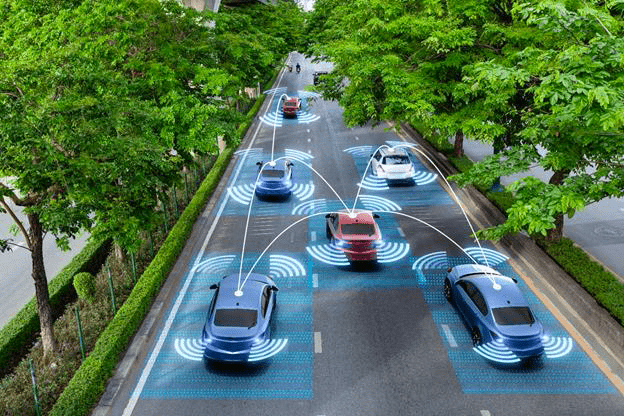
V2X technology uses sensors, cameras and wireless connectivity- like Wi-Fi, radio frequencies and 5G cellular technology for cars to connect and communicate with their drivers and surroundings. Cars have always communicated with drivers in elementary ways. For example, interior lights stay on when you accidentally leave a door open OR seatbelt reminders when occupants aren’t buckled in, etc. V2X technology promises that cars will be able to talk to pedestrians and bicyclists, traffic signals and road signs too. It creates a connection between cars and their surroundings that makes roads easier and safer to travel. 

Read more “V2X – Shaping Smart Cities”

MWB is leading AI Technology Solution Consulting company with multi-located offices and operations in GCC and abroad.

Copyright © 2016-2025 MWB Design Services . All Rights Reserved.